Radiator Installation

Radiator valves, bleeding and balancing

Thermostatic radiator valves fitted or replaced, systems bled and balanced so every radiator heats evenly, and inhibitor added. Typical UK costs.

In short: This service covers fitting or replacing thermostatic radiator valves and lockshields, bleeding trapped air out of radiators and balancing the system so every radiator heats up evenly. It suits homes where some radiators are cold, slow or noisy, or where old manual valves are leaking or seized. A TRV typically costs £40 to £90 per radiator fitted, and system balancing usually £100 to £250.

Get a free quote

Fixed price, no obligation. We aim to reply the same day.

By sending this form you agree to be contacted about your enquiry. See our privacy policy.

Radiator valves, bleeding and balancing

Many heating complaints are not about the radiators at all. A radiator that is cold at the top usually has trapped air; one that is cold at the bottom or in the middle often has sludge; and a house where the radiators nearest the boiler roast while the far ones stay lukewarm is usually out of balance. Balancing means setting the lockshield valve on each radiator so the hot water is shared out properly, rather than taking the easiest route.

Thermostatic radiator valves let each room be set to its own temperature, cutting the heat to rooms that are already warm. In England, since June 2022, room-by-room temperature control is required when a boiler is replaced in an existing home, and TRVs are usually the simplest way to meet it. Changing valves means opening up the system, so inhibitor should be checked and topped up at the same time.

What is included

  • Diagnosing cold, slow or noisy radiators
  • Bleeding air from radiators and checking system pressure
  • Fitting or replacing TRVs and lockshield valves
  • Freeing or replacing seized and weeping valves
  • Balancing the system using flow and return temperatures
  • Checking inhibitor strength and topping up
  • Advice on whether a system clean or power flush is needed

Who it is for

  • Radiators that are cold at the top, bottom or middle
  • Homes where far-away radiators never get properly hot
  • Old manual valves that are leaking, seized or passing
  • Anyone wanting room-by-room control to cut heating bills
  • Homes with a new boiler that needs TRVs added

How much does it cost?

As a guide, a TRV usually costs £40 to £90 per radiator fitted, bleeding and balancing a typical house £100 to £250, and a power flush, if needed, around £300 to £600. See our full cost guide.
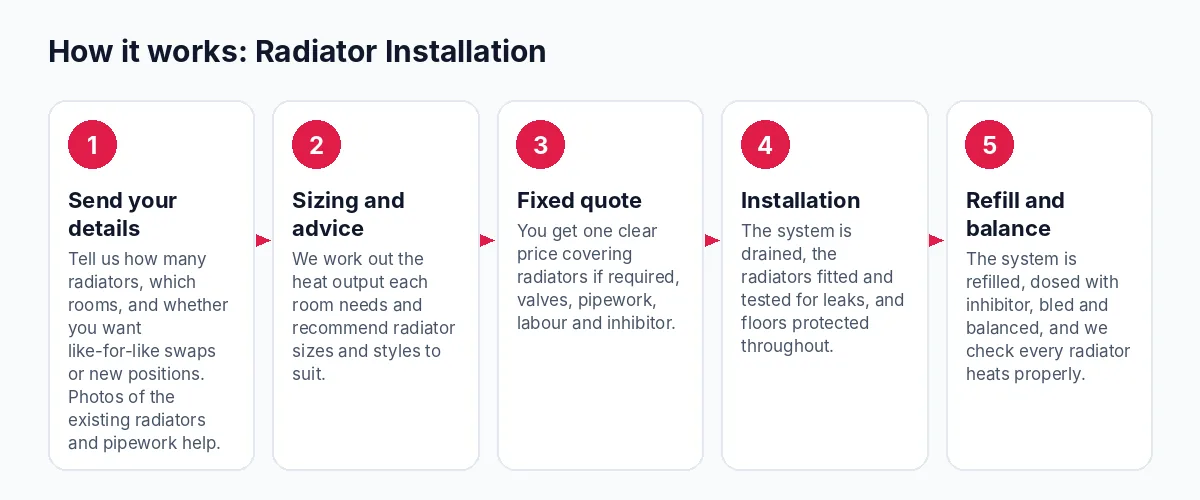
How it works

How radiator valves, bleeding and balancing works, step by step
  1. Diagnose the problem

    Each radiator is checked with the heating on to find which ones are cold, where, and whether the cause is air, sludge, a faulty valve or imbalance.

  2. Fix valves and air

    Faulty valves are replaced or freed, TRVs fitted where wanted, and air bled out, with sealed systems repressurised.

  3. Balance the system

    Lockshields are set, starting with the radiators nearest the boiler, so each one has a similar temperature drop across it.

  4. Protect and check

    Inhibitor is checked or topped up, and every radiator is rechecked once the system has run up to temperature.

Radiator valves, bleeding and balancing: FAQs

What is the difference between a TRV and a lockshield?

A TRV has a numbered head that senses the room temperature and opens or closes to keep it steady. The lockshield, on the other end of the radiator, usually has a plain cap and is set once by the installer to control how much water flows through, which is how the system is balanced. Neither should be used as an on and off switch.

Why is my radiator cold at the bottom?

A radiator that is warm at the top but cold along the bottom usually has sludge, a mix of rust and debris, settled inside it. Bleeding will not fix this. The radiator may need removing and flushing out, or the whole system may need a chemical clean or power flush, followed by inhibitor and ideally a magnetic filter.

Should every radiator have a TRV?

Most should. The usual exception is the radiator in the room where the main room thermostat is, which is often fitted with manual or lockshield valves at both ends so the thermostat and TRV do not fight each other. Some systems also need one radiator or a bypass left open to keep water circulating.

How often should I bleed my radiators?

Only when needed, usually when a radiator is cold at the top or you hear gurgling. If a radiator needs bleeding often, or a sealed system keeps losing pressure, there is likely a leak, a faulty expansion vessel or corrosion producing gas inside the system, which should be investigated.

Get a quote for radiator valves, bleeding and balancing

Send a few details and get one clear, fixed price, usually the same day.

Get a quote

Last updated 6 November 2026