Radiator Installation

Like-for-like radiator replacement

Old, leaking or rusting radiator swapped for a new one with matching pipe centres. What is included, how long it takes and typical UK costs.

In short: Like-for-like radiator replacement means swapping an old radiator for a new one of the same size and pipe centres, so the existing pipework can usually be reused. It suits homeowners and landlords with radiators that leak, rust or heat poorly but are the right size for the room. A single swap typically costs £180 to £400 in the UK including a standard radiator.

Get a free quote

Fixed price, no obligation. We aim to reply the same day.

By sending this form you agree to be contacted about your enquiry. See our privacy policy.

Like-for-like radiator replacement

Most radiators in UK homes are steel panel radiators made in standard heights and lengths, which makes a straight swap one of the simplest heating jobs there is. When the old radiator has pinhole leaks, rust at the bottom seam, flaking paint or cold patches that bleeding and flushing will not shift, replacing it is usually cheaper in the long run than repeated repairs and top-ups of the system.

The key measurement is the pipe centres: the distance between the two valve tails, or between the two pipes coming out of the floor or wall. If a new radiator with the same centres and similar output is chosen, it can be hung on new brackets and connected to the existing valves or new valves with little or no pipework change. Most single swaps are finished within one to two hours, including draining, refilling and bleeding.

What is included

  • Measuring the existing radiator, pipe centres and valve type
  • Matching a new radiator of equal or better heat output
  • Isolating or draining down the system as needed
  • Removing the old radiator and its brackets
  • Fixing new brackets securely to the wall type
  • Connecting to existing valves or fitting new TRVs and lockshields
  • Refilling, dosing with inhibitor, bleeding and leak testing
  • Taking away the old radiator if required

Who it is for

  • Radiators with pinhole leaks, rust or weeping seams
  • Rooms that heat well but have a tired or damaged radiator
  • Landlords refreshing a property between tenancies
  • Redecorating, where an old radiator spoils a new room
  • Anyone wanting a quick job with minimal disruption

How much does it cost?

As a guide, a single like-for-like swap usually costs £150 to £300 for labour only, or £180 to £400 with a standard double-panel radiator supplied. Doing several in one visit usually lowers the price per radiator. See our full cost guide.
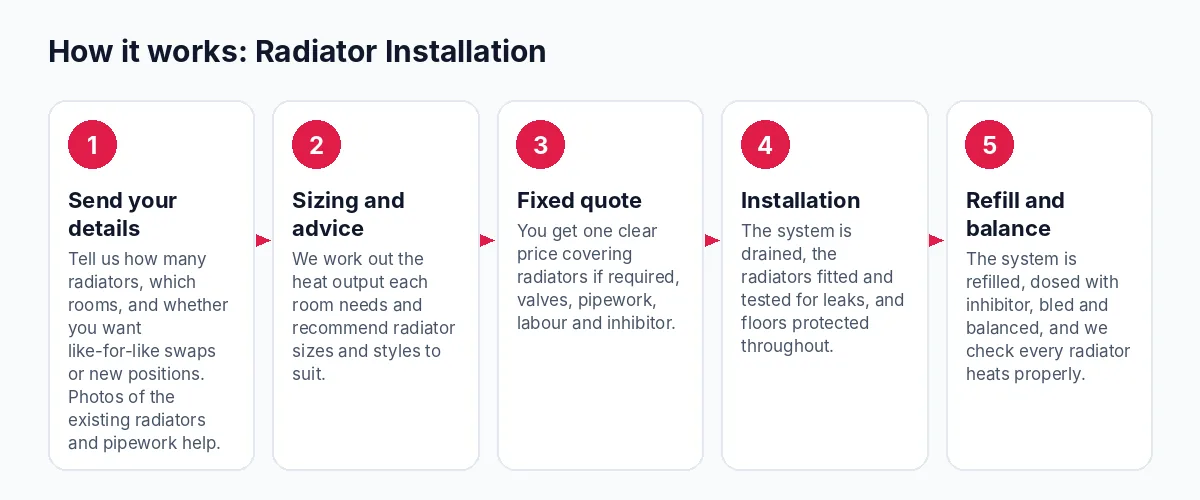
How it works

How like-for-like radiator replacement works, step by step
  1. Measure and match

    The width, height, panel type and pipe centres of the old radiator are recorded so a new one with matching connections and output can be chosen.

  2. Isolate or drain

    On many jobs the valves are closed and only the radiator is drained; if valves are seized or being changed, the system is drained down further.

  3. Swap and connect

    The old radiator comes off, new brackets go on, and the new radiator is hung, levelled and connected to the valve tails.

  4. Refill and check

    The system is refilled, repressurised if it is sealed, dosed with inhibitor, bled and checked for leaks with the heating running.

Like-for-like radiator replacement: FAQs

How do I measure pipe centres?

Measure from the middle of one pipe to the middle of the other where they come out of the floor or wall, or between the centres of the valve tails if the radiator is still on. Standard radiators are often sold with valve tail centres roughly 50 to 60 mm wider than the radiator length, so check the product details or send us a photo with a tape measure in shot.

Can I reuse my old valves?

Sometimes, if they turn freely and are not weeping, but old valves often seize or leak once disturbed. As the system is being opened up anyway, replacing them with new thermostatic valves and a matching lockshield usually costs little extra and gives better room control. Old valve tails also rarely suit a new radiator perfectly.

Will the new radiator be the same size?

It will match the pipe centres and fit the same space, but the heat output can differ. Older single-panel radiators can often be replaced with a double-panel model of the same height and length that gives noticeably more heat, as long as there is enough depth from the wall for it.

Does the whole system need draining?

Not always. If the valves on the radiator close fully, it can often be isolated and drained on its own, which saves time. If the valves are seized, passing water or being changed, the system is drained down further. Either way, inhibitor should be topped up when the system is refilled.

Get a quote for like-for-like radiator replacement

Send a few details and get one clear, fixed price, usually the same day.

Get a quote

Last updated 6 November 2026