Radiators sized for a boiler running at 70°C or more often cannot heat their rooms when the water is only around 45 to 50°C. At those temperatures a radiator gives out roughly half its quoted Delta T50 output, so the answer is more surface area: a deeper double-panel or triple-panel radiator, a longer radiator, or a fan-assisted model where space is tight. Not every radiator needs changing, which is why a room-by-room heat loss calculation matters.
Upgrading is often done alongside the heat pump installation, but it can also be done in advance while the boiler is still in place. Larger radiators work perfectly well with a boiler and let it run at a lower, more efficient flow temperature, so the work pays back even before the heat pump arrives. Pipework is also checked, as heat pumps need higher water flow rates and some older or microbore pipework may need upsizing.
What is included
- Reviewing the room-by-room heat loss figures
- Identifying which radiators are undersized at the design flow temperature
- Recommending larger, double-panel, triple-panel or fan-assisted replacements
- Checking pipe sizes for the higher flow rates a heat pump needs
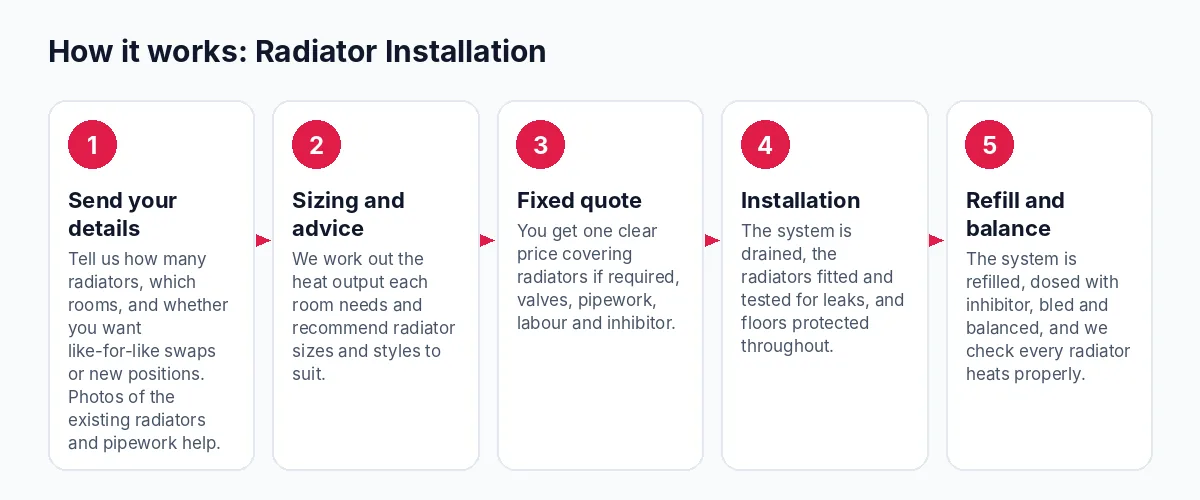
- Replacing radiators and valves, with pipework altered as needed
- Cleaning or flushing the system and fitting a filter where needed
- Refilling with inhibitor, bleeding and balancing for low-temperature running
Who it is for
- Homes about to have an air source or ground source heat pump
- Homes with a heat pump where some rooms never get warm
- Boiler owners wanting to run at lower, more efficient flow temperatures
- Extended or renovated homes with older, undersized radiators
- Homes with microbore pipework that may need upsizing
How much does it cost?
As a guide, upgrading a radiator for a heat pump usually costs £300 to £700 per radiator, depending on size and pipework. A whole house where several rooms need upgrading commonly runs to £1,500 to £5,000. See our full cost guide.